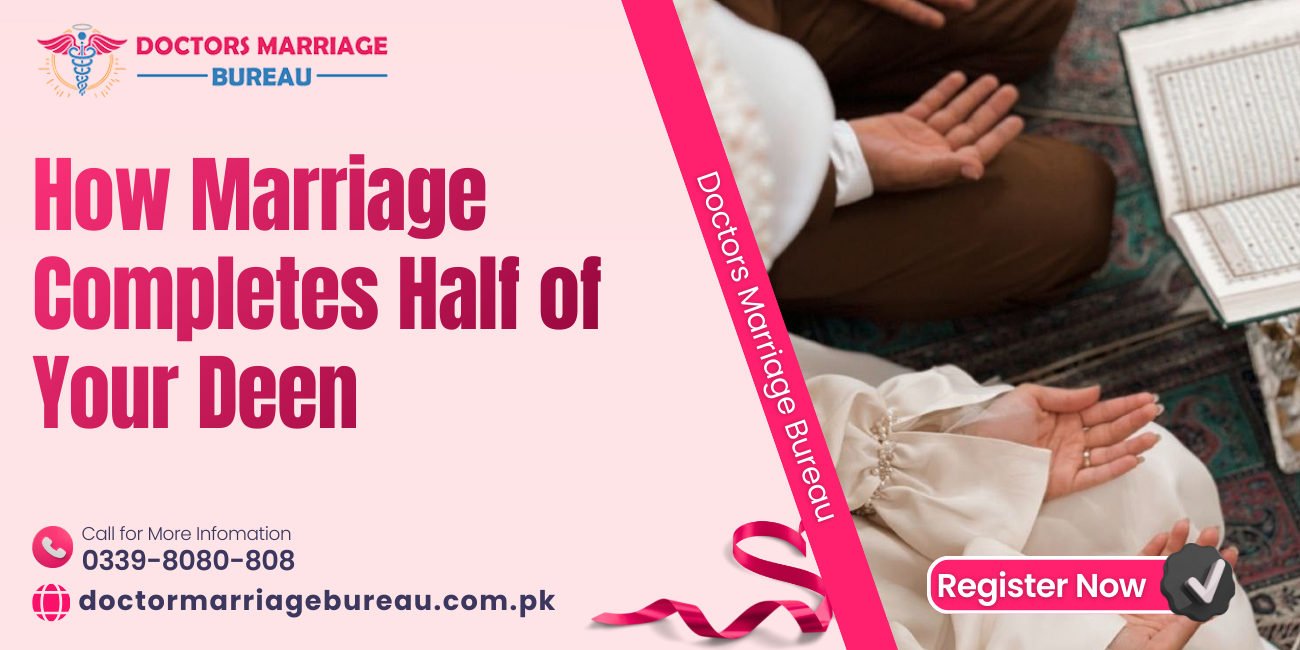
How Marriage Completes Half of Your Deen — Islamic Perspective & Practical Guide
Introduction
Marriage in Islam is not merely a social institution; it is an act of worship, an ethical contract, and a means by which two people support one another toward righteousness. A well-known hadith attributed to the Prophet Muhammad ﷺ states that marriage completes half of one’s faith (“an-nikah tukmilu nِaṣfi d-deen” is the common paraphrase). This profound statement captures both the spiritual significance of nikah and its practical implications for moral and social life.
This article examines the textual foundations of the claim, clarifies what “half of your deen” means in context, and offers practical guidance — particularly for Muslim professionals (including doctors) — on how to realize the spiritual, moral, and social benefits of marriage. Throughout, we combine Islamic sources, reasoned analysis, and actionable steps to help readers build marriages that strengthen faith, character, and family life.
1. Textual Foundations: The Hadith and Its Meaning
1.1 The Hadith on Marriage Completing Half the Deen
The expression that marriage completes half of one’s religion is widely cited among scholars and laypeople. Various narrations and juristic writings convey the idea that marriage secures half of the requirements for a believer’s well-being and social stability. The wording varies in classical sources, but the theme is consistent: marriage significantly aids a believer in meeting religious duties and achieving moral balance.
1.2 Scholarly Interpretation
Scholars interpret “half of your deen” not as a literal arithmetic fraction but as a metaphor conveying the substantial role marriage plays in facilitating religious practice and moral protection. Key points from the scholarly reading include:
-
Spiritual Support: Marriage provides companionship that encourages obedience, regular prayer, and moral restraint.
-
Social Stability: The family unit creates an environment to raise children with religious values and to sustain communal obligations.
-
Moral Safeguard: Marriage channels natural desires into a lawful framework, reducing fitnah (temptation) and social disorder.
Thus, the hadith indicates the profound ethical and social role of marriage in supporting a Muslim’s religious life.
2. Why Marriage Strengthens Religious Practice
2.1 Mutual Encouragement in Good Deeds
A properly oriented marital relationship involves spouses encouraging one another toward good deeds. Qur’an and Sunnah both emphasise mutual exhortation to righteousness. When spouses counsel each other toward punctual prayers, sincere repentance, and charitable acts, the household becomes a locus of spiritual growth rather than rivalry.
2.2 Regulating Natural Impulses
Islam recognises human instincts and offers marriage as a permissible, dignified channel for sexual and emotional needs. By providing lawful companionship, marriage reduces the risk of sinful behaviour, which in turn preserves religious standing and conscience.
2.3 Creating a Moral Environment for Children
Raising children in a stable, faith-based household ensures transmission of religious values across generations. A household that prioritises halal livelihood, prayer, Islamic etiquette, and learning supports the broader project of communal piety.
3. Practical Dimensions: How Marriage Completes “Half” of Deen
To render the metaphor practical, consider concrete ways marriage contributes to religious life:
-
Accountability: A spouse often acts as a moral mirror — reminding, advising, and correcting in loving ways.
-
Routine: Organised family life facilitates regular worship (shared Salah times, Qur’an recitation, Ramadan observances).
-
Companionship in Worship: Shared dhikr, charity, and pilgrimage are easier to plan and enact together.
-
Protection from Sin: The permissible channel of intimacy and companionship reduces the temptation to commit prohibited acts.
-
Social Duties: Marriage creates individuals capable of fulfilling communal responsibilities (raising righteous children, hosting community gatherings, sustaining family ties).
Each of these contributions helps a believer adhere to religious obligations more fully.
4. When Marriage Does Not Complete Deen: Warnings & Caveats
The hadith’s positive claim should not be misread to imply marriage is an automatic guarantee of piety. Several caveats are important:
-
Quality over Status: A dysfunctional marriage may damage one’s spiritual life. Abusive, neglectful, or manipulative relationships can lead to moral decline rather than uplift.
-
Intent and Sincerity: The spiritual benefits depend on sincere intentions and mutual commitment to faith. Marriage for status or convenience without religious aims may not strengthen deen.
-
Individual Responsibility: Each person remains individually accountable; marriage is a means and not an absolute substitute for personal worship and moral striving.
Therefore, choosing a spouse with piety, character, and compatible goals remains crucial.
5. Marriage for Professionals (Including Doctors): Specific Considerations
Muslim professionals, especially doctors, face unique pressures (long hours, emotional fatigue, mobility). For them, marriage can be especially instrumental in preserving deen — but only if certain conditions are met.
5.1 Seeking a Partner Who Supports Religious Practice
Professionals should seek partners who understand the realities of their vocation while sharing or supporting religious commitments. Practical examples:
-
Accommodating prayer times when schedules permit.
-
Encouraging religious study and mutual attendance at Islamic gatherings.
-
Understanding compromises during exigent professional periods (e.g., Ramadan fasting adaptations, combined prayers).
5.2 Mutual Practical Adjustments
Both spouses should be willing to negotiate practical accommodations: shared family routines, designated protected family time, and agreed-upon fallback plans during intense work periods.
5.3 Emotional Safety and Spiritual Growth
Doctors regularly face life-and-death decisions; a spouse who offers spiritual consolation and ethical reflection can help translate professional experience into deeper religious insight and compassion.
6. How to Make Marriage a Means to Complete Your Deen: A Practical Roadmap
Below are practical steps couples can adopt to ensure their nikah becomes a genuine support for their faith.
6.1 Intentional Niyyah (Sincere Intention)
Begin marriage with purposeful intention — to please Allah, to build a household of righteousness, and to raise children in faith. Revisit and renew this niyyah frequently.
6.2 Establish Shared Religious Practices
Agree on shared practices: set times for family Qur’an reading, select one night per week for attending Islamic lectures, and create simple household rituals of dhikr and dua.
6.3 Mutual Accountability without Harshness
Cultivate a culture of gentle accountability — reminding each other of missed prayers, encouraging voluntary fasts, and supporting repentance without shame.
6.4 Plan Spiritual Development Together
Set family goals: complete particular portions of Qur’an annually, enroll in study circles, and plan Hajj or Umrah when feasible. Shared projects reinforce unity and devotion.
6.5 Resolve Conflict According to Islamic Principles
Use prophetic guidance for conflict resolution: forgiveness, patience, consultation (shura), and when needed, professional mediation. Avoid actions that spiritually harm either spouse.
6.6 Protect Privacy and Reputation
Maintain discretion in family affairs. Protecting reputation aligns with Islamic ethics and reduces social stress that can harm religious practice.
7. Choosing a Spouse Who Helps You Grow in Deen
Selecting a spouse is central to actualising the hadith’s promise. Guidance:
-
Prioritise Character and Taqwa: Hadith literature emphasises faith and character as key selection criteria.
-
Assess Practical Compatibility: Consider routines, work demands, family expectations, and religious habits.
-
Use Verified Matchmaking: Platforms that verify intentions and backgrounds (e.g., [Doctors Marriage Bureau → https://panel.doctormarriagebureau.com.pk/register]) reduce risk of mismatch.
-
Involve Families and Scholars: Family insight and learned counsel can highlight compatibility and long-term fit.
8. Repairing Spiritual Decline within Marriage
If marriage has contributed to spiritual decline, steps to repair include:
-
Admit and Repent: Seek forgiveness, make sincere repentance, and recommit to change.
-
Open Communication: Discuss spiritual concerns without accusation; use “I” statements and propose mutual remedies.
-
Seek Counsel: Engage community leaders, trusted scholars, or marital counsellors with sensitivity to Islamic ethics.
-
Rebuild Shared Practices: Reintroduce joint worship, Quran recitation, and charitable projects.
-
Create Small Consistent Habits: Small, sustainable practices (e.g., two minutes of dhikr together daily) produce durable change.
9. Common Misunderstandings about the Hadith
9.1 “Marriage Alone Guarantees Paradise” — Incorrect
Marriage is a means, not a guarantee. One’s spiritual station depends on sincere faith and actions.
9.2 “Only Religious Partners Count” — Incomplete
While piety matters, practicality, kindness, and compatibility also contribute to a marriage that supports deen.
9.3 “Marriage Solves All Problems” — Unrealistic
Marriage can introduce new trials; couples must plan for conflict resolution, stress management, and mutual growth.
10. Practical Checklist: Making Your Marriage Strengthen Your Deen
-
Have a shared niyyah to build a faith-centred household.
-
Set regular family times for prayer reflection or Qur’an study.
-
Agree on compensatory practices for unavoidable professional interruptions.
-
Use verified services and family consultations when choosing a spouse.
-
Create a conflict-resolution plan rooted in Islamic ethics.
-
Engage in joint charitable or community activities.
-
Schedule periodic spiritual reviews — assess habits and goals together.
Conclusion
The notion that marriage completes half of one’s deen is a powerful reminder: nikah is intended as a spiritual and moral support, not mere social convenience. For Muslim professionals — including doctors — marriage can provide the companionship, accountability, and domestic structure necessary for flourishing in faith. Nevertheless, this result requires intention, character, and prudent choice.
Choose with piety and wisdom. Build with patience, mercy, and practical planning. If you are seeking a spouse who will support your deen and your life’s mission, consider starting with a verified, faith-oriented platform that understands professional realities.
[Register Now → https://panel.doctormarriagebureau.com.pk/register]
Author Bio
Doctors Marriage Bureau Team
The Doctors Marriage Bureau team specialises in faith-aligned, verified matrimonial services tailored for Muslim professionals. Combining Islamic guidance with professional verification, we assist serious seekers in finding partners who strengthen both faith and family. For secure registration and personalised matchmaking, visit: https://panel.doctormarriagebureau.com.pk/