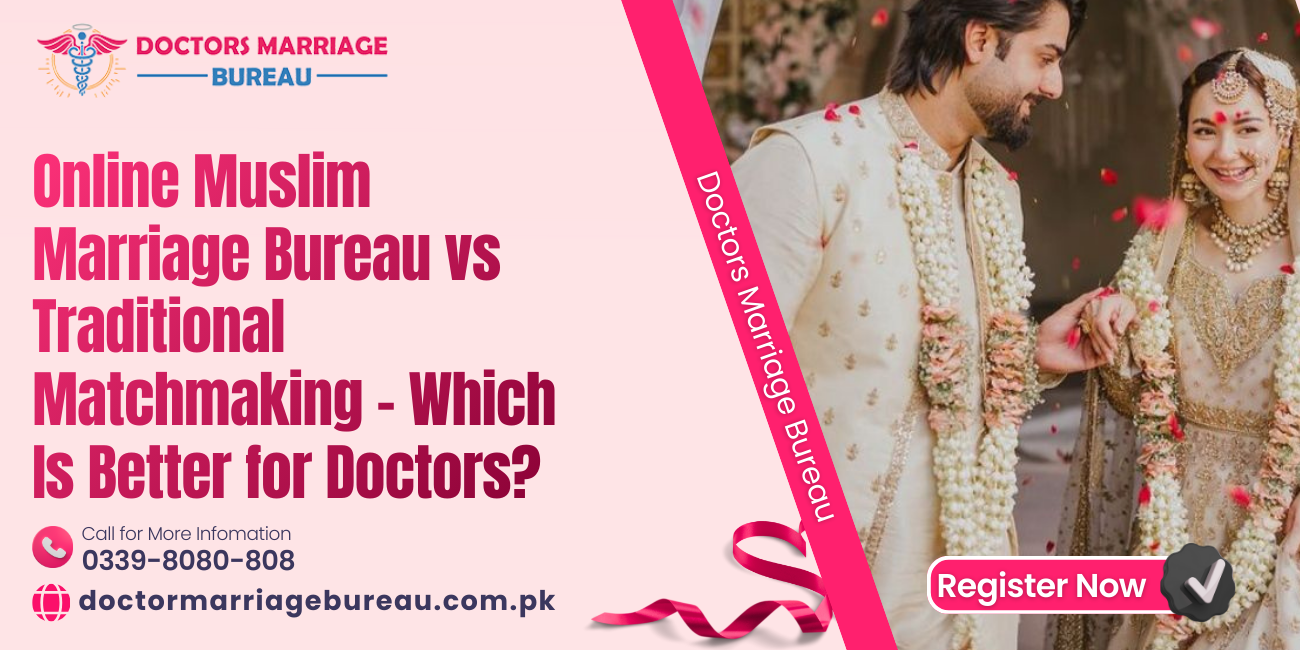
Online Muslim Marriage Bureau vs Traditional Matchmaking — Which Is Better for Doctors?
Introduction
Choosing a life partner is a decision of profound consequence. For Muslim doctors — professionals who balance demanding careers with religious and family responsibilities — the method of finding a spouse must reflect both practicality and principle. In recent years, two primary pathways have dominated: the traditional matchmaking route (family-arranged introductions, community networks, and local rishta bureaus) and online Muslim marriage bureaus that claim to combine technology, verification, and faith-based standards.
This article provides a formal, evidence-based comparison of both approaches with the specific needs of Muslim doctors in mind. Drawing on practical aspects such as time constraints, privacy, verification, family involvement, and the maintenance of Islamic etiquette, we examine which approach — or combination of approaches — best supports a doctor’s quest for a compatible, halal, and long-term partnership.
Throughout this guide we will reference how a specialised platform like Doctors Marriage Bureau addresses the particular needs of medical professionals.
[Register Now → https://panel.doctormarriagebureau.com.pk/register]
1. Defining the Two Approaches
Traditional Matchmaking
Traditional matchmaking typically refers to introductions through family, friends, local community networks, mosque contacts, or older-style rishta bureaus. It is characteristically personal, family-centred, and rooted in social reputation and community endorsement.
Key attributes:
-
Family-led vetting and introductions
-
High degree of direct family involvement
-
Relies on community reputation and word-of-mouth
-
Often conducted offline (meetings, phone calls, family visits)
Online Muslim Marriage Bureaus
Online Muslim marriage bureaus are platforms (websites or specialised services) that use digital tools to match individuals. Verified bureaus combine digital convenience with manual verification, privacy controls, and often tailored service for professionals.
Key attributes:
-
Digital reach and filtering tools (profession, education, religiosity)
-
Document and ID verification processes
-
Confidential communication channels
-
Human-assisted matching and consultation for serious users
2. Which Factors Matter Most to Muslim Doctors?
Before comparing strengths and weaknesses, it is essential to outline the factors that typically influence a doctor’s choice:
-
Time Efficiency — Doctors often have limited time; efficient matching processes are crucial.
-
Privacy & Professional Reputation — Medical professionals guard their personal and professional reputations; discreet processes are preferred.
-
Verification & Authenticity — Confirmed education, licence, workplace, and family background reduce risk.
-
Faith Alignment — Observance and values in line with Islamic principles are commonly prioritized.
-
Family Involvement — In many Muslim cultures, family participation is important and expected.
-
Geographic Mobility — Doctors may train or practise abroad; the ability to connect internationally matters.
-
Quality of Matches — Preference for educated, career-aligned partners who understand the medical lifestyle.
These criteria will form the basis for comparison.
3. Comparison: Advantages & Disadvantages
A. Time Efficiency & Accessibility
Traditional Matchmaking
Advantages:
-
High contextual knowledge from family / community; introductions often well-vetted socially.
Disadvantages: -
Slow; depends on social networks and timing. Doctors with limited availability may not receive timely proposals.
Online Bureaus
Advantages:
-
Rapid searching via filters (specialisation, location, religious practice). Doctors can review curated matches at convenient times.
-
24/7 access independent of social calendars.
Conclusion: For busy physicians, online bureaus often provide materially greater time efficiency while preserving selectivity.
B. Privacy & Professional Reputation
Traditional Matchmaking
Advantages:
-
Personal, family-mediated introductions tend to protect privacy locally.
Disadvantages: -
Social complications can arise if an introduction does not proceed smoothly; confidentiality depends on family discretion.
Online Bureaus
Advantages:
-
Verified platforms allow private profiles, controlled visibility, and confidential messaging. Professional identity verification reduces risk of misrepresentation.
Disadvantages: -
Poorly managed platforms may leak data; selection of a reputable bureau is essential.
Conclusion: Reputable online bureaus with strict privacy policies generally better protect a doctor’s professional reputation — provided verification and data security are robust.
C. Verification & Risk Management
Traditional Matchmaking
Advantages:
-
Community reputation and family references offer a form of social verification.
Disadvantages: -
Social verification may not reveal professional details (licenses, specialisations) and is limited when the match is outside local circles.
Online Bureaus
Advantages:
-
Digital verification — ID checks, degree and licence proof, hospital or employer confirmation — provides objective validation.
Disadvantages: -
Not all online services verify; vetting processes differ widely.
Conclusion: For professional credibility, a verified online bureau is superior if it enforces strict documentation checks.
D. Faith & Cultural Alignment
Traditional Matchmaking
Advantages:
-
Families and community leaders are adept at assessing religious, cultural, and familial fit.
Disadvantages: -
Community selection may prioritize social factors over personal compatibility or professional demands.
Online Bureaus
Advantages:
-
Many platforms allow fine-grained filtering for religiosity, practice, and cultural preferences; faith-aligned filters can be explicitly set.
Disadvantages: -
Without family engagement, some nuances of family expectations may be missed.
Conclusion: Optimal approach combines online filtering for faith alignment with traditional family involvement for cultural nuance.
E. Geographic Reach & Mobility
Traditional Matchmaking
Advantages:
-
Strong locally; limited internationally unless diaspora networks are large.
Disadvantages: -
Poor for cross-border matching; problematic for doctors trained or practising abroad.
Online Bureaus
Advantages:
-
Global reach; invaluable for doctors in diaspora communities or those seeking matches across countries.
Disadvantages: -
Cross-cultural legalities and relocation logistics remain complex.
Conclusion: Online bureaus give a decisive advantage for internationally mobile doctors.
F. Cost & Practicality
Traditional Matchmaking
Advantages:
-
Often low cash cost if family networks are used.
Disadvantages: -
Time cost and social capital expenditure can be high.
Online Bureaus
Advantages:
-
May require subscription fees or consultancy charges, but yield higher efficiency and verification.
Disadvantages: -
Costs vary; quality comes at a price.
Conclusion: Doctors may find paid, verified services cost-effective given time savings and reduced risk.
4. Specific Considerations for Doctors
4.1 Shift Work and Availability
Doctors have erratic and lengthy schedules. A platform that allows asynchronous review (messages, vetted profiles, scheduled consults) fits better than sporadic, in-person introductions.
4.2 Professional Confidentiality
Physicians value confidentiality — both personal and patient-related. Verified online platforms with strict privacy controls and non-disclosure standards are preferable.
4.3 Professional Standing & Licensure
For doctors, confirmation of licensure, specialisation, and training is important. A platform that validates GMC/PMDC/RCPS/other local/foreign credentials reduces the risk of misrepresentation.
4.4 Peer Understanding
Doctors often seek partners who understand on-call demands and responsibilities. Matching by profession or by allied healthcare background increases the probability of mutual empathy.
5. The Hybrid Model: Best of Both Worlds
Rather than treating the question as binary, many professionals benefit most from a hybrid model:
-
Begin with a verified online bureau to filter, verify, and identify qualified matches efficiently.
-
Introduce family involvement once initial compatibility is established.
-
Use traditional channels for final vetting, trust-building, and cultural reconciliation.
This approach preserves the speed and verification of online services while retaining the social legitimacy and family support of traditional matchmaking.
6. Verification, Security & Red Flags — What to Require
Whether using online services or traditional networks, doctors should insist on clear verification and safe practices:
Required Verification Standards
-
Government ID and professional licence checks.
-
Proof of medical degree and current employer/hospital.
-
Background checks for criminal history where applicable.
-
Family references or community endorsements (for cultural fit).
Security Practices
-
Use platforms with HTTPS, clearly stated privacy policies, and data retention rules.
-
Ensure communication initially occurs on the platform (not direct mobile/WhatsApp) until both parties and families consent.
Red Flags
-
Reluctance to provide verifiable professional information.
-
Pressure to move private communication off-platform prematurely.
-
Requests for money or unusually rapid marriage pressure.
A reputable online bureau will enforce verification and will guide users away from risky behaviour.
7. Family Involvement: How Much and When?
Family involvement is central to Muslim matrimonial practice and often contributes to long-term stability. For doctors:
-
Early transparency with families reduces later friction.
-
Use online matching to identify candidates; then involve families for cultural and practical vetting.
-
Respect family processes: background conversations, meetings, and involvement of elders.
Professional bureaus should support family integration by providing family-friendly communication options and mediation services.
8. Success Metrics: What Drives a Good Outcome?
When evaluating any matching channel, consider measurable outcomes:
-
Match quality: professional, religious, and lifestyle alignment.
-
Time to serious proposal: speed from first contact to family-approved proposal.
-
Privacy preservation: no unauthorized profile exposure.
-
Sustainability: compatibility leading to successful Nikah and marital satisfaction.
Data from verified bureaus often show higher match-quality and faster progression for professional users due to targeted filtering and human curation.
9. Cost-Benefit Analysis for Doctors
Consider the following simplified calculus:
-
Time value: The opportunity cost of a doctor’s hours is high. Paid verified services that save multiple months of searching can be cost efficient.
-
Risk reduction: Financial and emotional costs of misrepresentation are high; verification lowers these risks.
-
Family peace: Efficient processes reduce family stress and prevent prolonged negotiations.
Thus, while upfront fees for verified services exist, for many doctors the net benefit is positive.
10. How to Choose the Right Platform (Checklist)
When selecting an online bureau or deciding to rely on traditional networks, doctors should apply this checklist:
-
Verification Rigor: Do they verify degrees, licences, and ID?
-
Privacy Policy: Is data handling explicit and secure?
-
Family Integration Tools: Are families supported and included?
-
Professional Specialisation: Does the bureau cater to doctors/healthcare professionals?
-
Human Support: Is there a consultant or relationship manager?
-
Reputation & Testimonials: Are success stories verifiable?
-
Legal & Cultural Sensitivity: Do they understand cross-border implications?
-
Cost Transparency: Are fees and refund policies clear?
If the bureau meets most criteria, it can be utilised as the primary channel, supplemented by family introductions.
11. Practical Roadmap for a Doctor Using Both Approaches
-
Clarify priorities: faith practice, specialisation, location, family expectations.
-
Register on a verified platform with profession-specific filters. [Register Now → https://panel.doctormarriagebureau.com.pk/register]
-
Create an honest, professional profile (education, licensure, hospital/clinic).
-
Shortlist matches digitally and conduct initial conversations with adab (etiquette).
-
Introduce families when both parties express mutual interest.
-
Perform traditional vetting (family references, local community checks).
-
Complete verification checks (documents, employer confirmation).
-
Make du’a and perform Istikhara before final decisions. (Light Islamic reference: seeking Allah’s guidance is recommended in major decisions.)
-
Proceed to formal engagement (Nikah) with families present and satisfaction with verification.
This roadmap blends efficiency with cultural and religious integrity.
12. Case for Doctors Marriage Bureau (How a Specialist Platform Helps)
A specialist platform such as Doctors Marriage Bureau addresses most concerns described above:
-
Profession-focused verification and filters (specialisation, practice location)
-
Confidential, family-friendly communication flow
-
Human curation to reduce time and increase match relevance
-
Islamic ethical framework integrated into workflows
For doctors seeking a balance of speed, accuracy, and faith alignment, a reputable specialist bureau is often the superior first step.
[Success Stories → https://panel.doctormarriagebureau.com.pk/happy-stories]
13. Final Recommendation
There is no universal answer — but for the typical Muslim doctor the hybrid approach is most advisable:
-
Start with a verified online bureau that specialises in professionals to benefit from screening, time efficiency, and global reach.
-
Transition to traditional/family-based verification and involvement once compatibility is established.
This strategy utilises the strengths of both methods while mitigating their respective weaknesses. It respects Islamic principles of family involvement and transparency while acknowledging the modern realities of professional life.
Conclusion
Doctors face unique constraints and responsibilities that influence how they should search for a life partner. Traditional matchmaking provides deep social vetting and family integration, while verified online bureaus deliver speed, privacy, and authentication. For Muslim doctors, the choice is not exclusive: using a verified, profession-focused online service as the primary discovery tool and then involving family networks for final vetting combines the best attributes of both systems.
If you are a Muslim doctor seeking a thoughtful, verified, and faith-aligned path to Nikah, consider a specialist bureau that understands your profession and your principles. Begin your search with a platform tailored to your needs and integrate family involvement at the right stage to ensure both efficiency and cultural authenticity.
[Register Now → https://panel.doctormarriagebureau.com.pk/register]
Author Bio
Doctors Marriage Bureau Team
Doctors Marriage Bureau specialises in verified, faith-aligned matrimonial services for medical professionals. With a focus on privacy, verification, and family-friendly processes, our platform supports Muslim doctors worldwide in finding compatible, long-term partners. For guided assistance and secure matchmaking, visit:
🌐 https://panel.doctormarriagebureau.com.pk/
📞 For assistance: use the contact form on our website.